How to Check for Rental Scams Before Signing a Lease
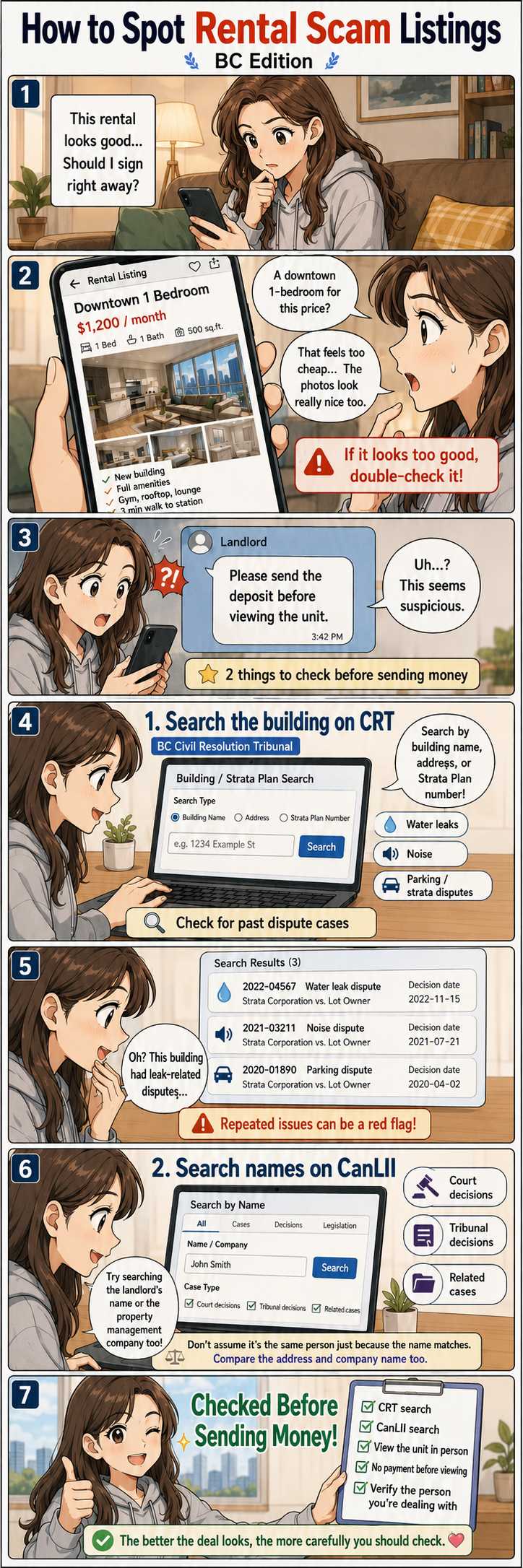
When searching for a rental home in Canada, you may occasionally come across listings that are noticeably cheaper than the market rate or seem almost too good to pass up based on the photos and conditions. This is especially common in competitive rental markets like Vancouver, where renters may feel pressured to contact the landlord and secure a property quickly before someone else takes it.
Unfortunately, rental scammers often take advantage of this sense of urgency. Common warning signs include being asked to pay a deposit before seeing the property, or being told that the landlord is currently overseas and cannot meet in person but still wants payment in advance. In some cases, scammers may even copy photos from legitimate online listings and repost them as if they own or manage the property.
For this reason, it is important to verify as much information as possible before signing a lease or sending any money.
Two useful resources you can use in British Columbia are the BC Civil Resolution Tribunal (CRT) and CanLII.
Check a Building’s Dispute History Through the CRT
The BC Civil Resolution Tribunal (CRT) handles a range of civil disputes in British Columbia, including many cases involving strata properties.Its publicly available decisions can include disputes related to water leaks, noise complaints, parking issues, strata bylaws, maintenance concerns, and conflicts between owners and strata corporations. These records can provide useful information about issues that may have occurred in a condo or apartment building.
If you find a rental property you are interested in, try searching for the building name, address, or Strata Plan number.
The search results may give you an idea of what kinds of disputes have occurred in the building in the past. If you notice several cases involving the same type of problem, it may be worth looking into the issue more carefully before signing a lease.
For example, if a particular building repeatedly appears in disputes involving water leaks, noise, or parking, you may want to ask additional questions about those issues when viewing the property.
However, the existence of a CRT dispute does not automatically mean that there is something wrong with the building. Larger strata developments may naturally have more disputes simply because they contain more units and residents.
Instead of focusing only on whether a dispute exists, look at whether the same type of issue appears repeatedly and whether similar disputes have continued in recent years.
Search the Landlord or Property Management Company on CanLII
Another useful resource is CanLII.CanLII is a Canadian legal information database that provides access to court judgments and decisions from various tribunals and administrative bodies. Because its coverage is broader than the CRT alone, it can also be useful when researching the person or company involved in a rental listing.
For example, you can search the name of the landlord advertising the property to see whether the same name appears in previous rental-related disputes or legal cases.
If the property is managed by a Property Management Company, you can also search the company name to see whether there are any relevant decisions or cases associated with it.
However, name searches should always be interpreted carefully. Two people can share the same name, so a search result should never be treated as proof that the person in a court decision is the same individual you are dealing with.
Instead, compare additional information such as the address, company name, location, and details of the case before drawing any conclusions.
Of course, checking online records is only an additional precaution. The most important steps are still to verify the property itself and confirm the identity of the person you are dealing with.
Take One More Step Before Signing a Rental Agreement
Finding no results on CRT or CanLII does not necessarily mean that a rental listing is legitimate or completely risk-free.These websites should be treated as additional tools that can help you gather more information before entering into a rental agreement.
Whenever possible, visit the property in person and confirm that the address in the listing matches the actual unit. You should also verify whether the person showing the property is the owner, an authorized property manager, or an agent acting on behalf of the owner.
You should be especially cautious if someone asks you to send a deposit or rent payment before you have even viewed the property.
This can be particularly difficult in Vancouver, where desirable rental listings often receive significant interest and renters may feel pressure to act quickly. However, the better the deal appears, the more important it is to slow down and verify the details.
When renting a home, securing a good property quickly is important, but confirming that the property and the person you are dealing with are legitimate before sending money should always come first.
If you are looking for a rental property in Canada or have questions about the rental process, please feel free to contact Hellomark.
We are here to help you navigate the Canadian rental process and better understand the information you should check along the way.

